China Top 10 Cold Plunge Tub Manufacturers?
Choosing the right Cold Plunge Tub requires more than comparing prices, shapes, and glossy product photos. Chinese manufacturers now offer compact home units, insulated outdoor tubs, commercial recovery systems, and models with integrated cooling technology. However, quality can vary between suppliers, even when their specifications appear similar.
Dr. Susanna Søberg, a cold-exposure researcher and author, has said, “The cold shock response is the body’s first response to cold water immersion.” Her comment highlights an important point: temperature control, user safety, and reliable construction matter more than appearance alone. A well-made tub should maintain stable water temperatures, resist corrosion, drain efficiently, and provide clear operating instructions. It should also support practical hygiene, especially when several people use it.
Details matter.
This guide examines China’s top 10 Cold Plunge Tub manufacturers through a buyer’s perspective. It considers product design, cooling performance, insulation, materials, customization, certifications, production experience, and after-sales support. Factory communication also deserves attention. Delayed answers can become expensive problems later.
Some rankings may remain debatable. Public information is not always consistent, and smaller factories may have stronger capabilities than their websites suggest. That limitation deserves honest recognition. Therefore, readers should verify test reports, request samples, inspect manufacturing facilities when possible, and confirm warranty terms before placing an order. The goal is not to praise every supplier. It is to identify manufacturers that appear dependable, technically capable, and suitable for different purchasing needs.
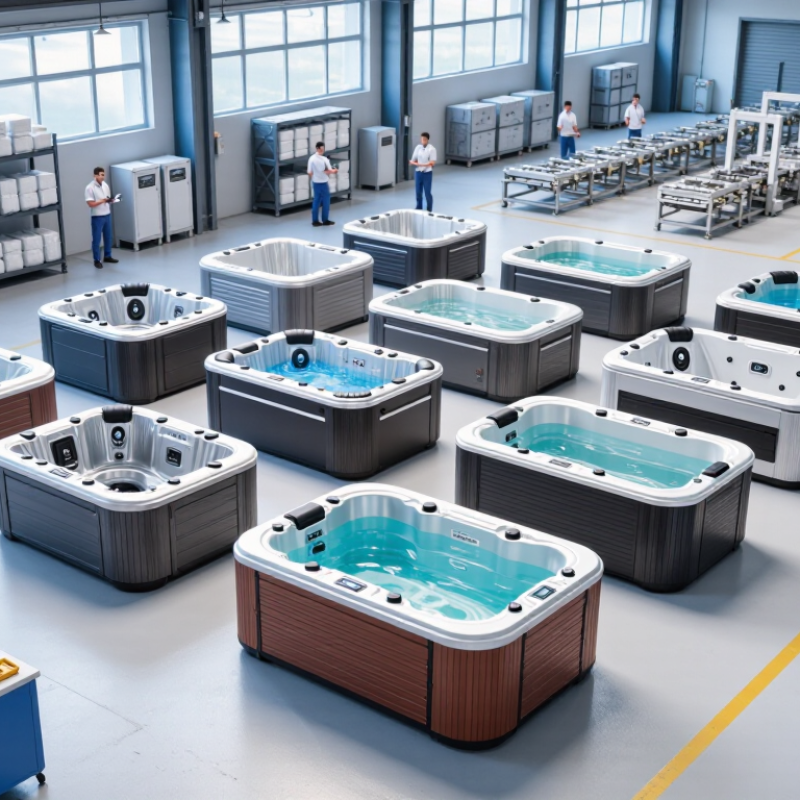
Defining China’s Cold Plunge Tub Market and the Top 10 Selection Criteria
China’s cold plunge tub market has moved from small workshop production toward specialized, export-oriented manufacturing. Buyers now compare more than appearance. They examine materials, cooling performance, hygiene, safety, and service reliability.
A practical top-ten selection begins with tub material and structural strength.
Look for durable acrylic, stainless steel, or reinforced composite construction.
Second, inspect insulation around the shell and plumbing.
Third, measure cooling speed under realistic water temperatures.
Fourth, check filtration and sanitation access.
Fifth, review electrical protection and temperature controls.
Sixth, compare energy use during repeated cooling cycles.
Seventh, assess drainage, cleaning, and replacement-part design.
Eighth, request customization limits, including dimensions, fittings, and packaging.
Ninth, verify factory testing records and product documentation.
Tenth, evaluate production capacity, quality consistency, and after-sales communication.
Hands-on testing matters.
Fill a sample tub, record cooling time, inspect condensation, and listen for unusual compressor noise. Ask for photos of internal pipework, not only showroom images.
A polished catalog can still hide weak insulation or difficult maintenance. Factory audits, batch inspection, and clear warranty terms improve reliability, but they do not remove every risk. No checklist is perfect.
Smaller manufacturers may offer faster customization, yet their spare-part systems can be less mature. Larger factories often provide stronger testing processes, although communication may feel slower. Buyers should compare operating evidence, not promises, before choosing a long-term manufacturing partner.
Comparing Cooling Performance: 4–15°C Water Temperature and kW Capacity
China Top 10 Cold Plunge Tub Manufacturers?
Cooling performance matters more than attractive cabinet finishes. For a 1,000-liter tub, lowering water by 1°C requires about 1.16 kWh of thermal removal. This calculation uses water’s specific heat, 4.186 kJ/kg·K, a value referenced in the ASHRAE Handbook—Fundamentals. A 20°C tub reaching 10°C therefore needs roughly 11.6 kWh, before accounting for covers, pipes, users, and room heat.
Temperature range alone proves little. A system rated at 4°C may struggle during repeated use if its condenser rejects heat into a warm indoor room. Buyers should ask whether the stated kW means cooling output or electrical consumption. A 1.5 kW cooling unit drawing 0.5 kW has a theoretical COP of 3.0. The U.S. Department of Energy and AHRI testing practices distinguish useful cooling capacity from input power, so unclear specifications deserve caution.
Real testing should record water volume, starting temperature, ambient temperature, and pull-down time. Measure it.
At 15°C, a modest system may cool steadily. Reaching 4°C demands stronger refrigeration and better insulation. The 2023 ASHRAE Handbook—Refrigeration emphasizes heat-load evaluation, yet small-tub sellers often publish ideal laboratory figures. I would not compare kW figures without checking test conditions. That is where many rankings become unreliable. Even a well-built tub can lose performance when its cover remains open, the filter clogs, or warm bathers enter repeatedly.
China Top 10 Cold Plunge Tub Manufacturers? - Comparing Cooling Performance: 4–15°C Water Temperature and kW Capacity
Anonymous comparison of representative commercial cold-plunge configurations manufactured in China
| Profile | Recommended Water Range | Minimum Setpoint | Nominal Cooling Capacity | Electrical Input | Typical Tub Volume | Cooling Rate* | Pump Flow Rate | Filtration | Best-Fit Application |
| Profile 01 | 4–15°C | 4°C | 0.80 kW | 0.40–0.55 kW | 250–350 L | 1.5–2.0°C/h | 20–30 L/min | Cartridge filter | Home users and compact indoor installations |
| Profile 02 | 4–15°C | 4°C | 1.00 kW | 0.50–0.70 kW | 300–450 L | 1.8–2.4°C/h | 25–35 L/min | Cartridge filter + ozone | Residential wellness rooms and gyms |
| Profile 03 | 4–15°C | 4°C | 1.20 kW | 0.60–0.85 kW | 350–500 L | 2.0–2.7°C/h | 30–40 L/min | Cartridge filter + UV | Frequent personal use and boutique fitness studios |
| Profile 04 | 4–15°C | 4°C | 1.40 kW | 0.70–0.95 kW | 400–600 L | 2.2–3.0°C/h | 35–45 L/min | Cartridge filter + ozone | Athlete recovery and small commercial facilities |
| Profile 05 | 4–15°C | 4°C | 1.60 kW | 0.80–1.10 kW | 450–650 L | 2.4–3.2°C/h | 40–50 L/min | Cartridge filter + UV/ozone | High-frequency home and professional training use |
| Profile 06 | 4–15°C | 4°C | 1.80 kW | 0.90–1.25 kW | 500–750 L | 2.5–3.4°C/h | 45–55 L/min | Cartridge filter + ozone | Sports clubs, spas, and recovery centers |
| Profile 07 | 4–15°C | 4°C | 2.00 kW | 1.00–1.40 kW | 600–850 L | 2.6–3.6°C/h | 50–65 L/min | Multi-stage filter + UV | Commercial wellness and hospitality facilities |
| Profile 08 | 4–15°C | 4°C | 2.20 kW | 1.10–1.50 kW | 700–950 L | 2.8–3.8°C/h | 55–70 L/min | Multi-stage filter + ozone | Multiple daily users and performance centers |
| Profile 09 | 4–15°C | 4°C | 2.40 kW | 1.20–1.65 kW | 800–1,100 L | 3.0–4.0°C/h | 60–75 L/min | Multi-stage filter + UV/ozone | Large gyms, hotels, and sports medicine clinics |
| Profile 10 | 4–15°C | 4°C | 2.80 kW | 1.40–1.95 kW | 900–1,300 L | 3.2–4.3°C/h | 70–90 L/min | Commercial filtration + ozone/UV | Heavy-duty commercial and multi-user installations |
Technical note: Cooling rates are indicative values for a covered, insulated tub under approximately 25°C ambient conditions. Actual performance varies with water volume, insulation, initial water temperature, ambient temperature, airflow, cover usage, and heat gain from users. Nominal cooling capacity refers to refrigeration output, while electrical input refers to approximate compressor and system power consumption.
Evaluating Tub Design: 304/316 Stainless Steel, Insulation, and Volume
When comparing China’s top cold plunge tub manufacturers, examine the steel before the styling. 304 stainless steel suits most indoor and sheltered outdoor installations. It offers strong durability and reasonable corrosion resistance. 316 stainless steel performs better near salt air, chlorinated areas, or frequent outdoor exposure. However, 316 is not automatically the better choice for every buyer. Welding quality, surface finishing, and drainage design can matter more than the grade alone. Ask manufacturers for material certificates and close-up images of welded corners.
Insulation controls cooling speed, energy use, and water stability. Look for closed-cell foam around the tub, insulated covers, and sealed plumbing connections. Thin insulation may feel acceptable during a factory inspection but disappoint during repeated summer use. Volume also deserves careful measurement. A larger tub uses more water and requires more cooling power. A compact model may cool faster, yet restrict shoulder movement. Measure the user’s height, sitting posture, and available floor space. I have seen buyers choose impressive capacity and later regret the cleaning workload.
Tips: Request the empty weight, internal dimensions, insulation thickness, and tested temperature range. Check whether the pump and filter are easy to access. Ask how the manufacturer handles leaks and replacement parts. Do not rely only on attractive product photos. A factory’s technical answers often reveal more than its catalog.
Assessing Filtration, Water Turnover, Energy Use, and Safety Compliance
China’s top 10 cold plunge tub manufacturers should be assessed beyond price and exterior design. The Global Wellness Institute valued the global wellness economy at $6.3 trillion in 2023. That growth increases pressure on manufacturers to prove performance with measurable data.
Filtration is the first practical test. A strong system should state filter media, flow rate, and tested water turnover. The 2023 CDC Model Aquatic Health Code treats circulation, filtration, and disinfection as connected controls. However, its public-pool guidance should not be copied blindly for household tubs. Water turnover must match the tub’s volume, bather load, and operating temperature. A clear calculation matters more than a large pump label.
Energy use also needs independent checking. Ask for standby consumption, cooling recovery time, and performance at different room temperatures. A tub may cool quickly but waste energy overnight. That trade-off is easy to miss. Safety compliance deserves equal attention. NSF/ANSI 50 provides relevant criteria for recreational water equipment, while electrical protection should include tested leakage protection and weather-resistant components. Manufacturers should document insulation, grounding, sanitation limits, and emergency shutoff design. Ozone or ultraviolet treatment is not automatically a replacement for residual disinfection. I would also question unclear laboratory claims, because some specifications report ideal conditions rather than daily use.
Comparing the Top 10 Manufacturers by OEM Service, Warranty, and Certifications
China Top 10 Cold Plunge Tub Manufacturers?
Comparing ten manufacturers requires more than checking product photos and advertised prices. OEM capability should be judged through drawings, sample approval, insulation design, controller options, packaging, and production consistency. A reliable factory explains its process clearly. Ask whether it can modify dimensions, drainage, filtration, cooling capacity, and electrical specifications. Request a working sample before placing a large order. Small details matter.
Warranty terms reveal practical confidence. Compare coverage for the tub shell, chiller, pump, controller, and seals separately. Check response times, replacement procedures, labor exclusions, and spare-part availability. Some warranties sound generous but exclude the parts most likely to fail. That is easy to miss. Certifications also need careful verification. Confirm that documents match the exact model, factory, and destination market. Product safety, electromagnetic compatibility, materials, and quality-management certificates should not be treated as interchangeable. Certification claims without traceable reports deserve caution.
Tips: Request test records, serial-number tracking, water-leak checks, and temperature-performance data. Contact two previous buyers if possible. A factory may offer excellent OEM support but weak after-sales service, or the reverse. I would score both areas separately. My own comparison could still overlook seasonal production delays, so written commitments and a pilot order remain sensible safeguards.