
Who Are the Top 10 Main Door Lock Manufacturers in China?
A Main Door Lock is more than a metal cylinder beside a handle. It is the first barrier a family touches when leaving home, and the last one they check at night. Buyers may compare steel grades, cylinder designs, finish quality, smart features, and after-sales support. Yet a polished catalogue cannot prove how a lock performs after years of daily use.
Bruce Schneier, a widely recognized security technologist, wrote, “Security is a process, not a product.” That idea matters when evaluating Chinese manufacturers. A dependable lock depends not only on its design, but also on production consistency, installation, maintenance, and the door around it. Small details matter. A stiff key or loose latch can change the daily experience.
This guide introduces ten notable Main Door Lock manufacturers in China and the strengths that distinguish them. It considers product range, manufacturing capability, market presence, and evidence available to buyers. These factors are useful, but they do not replace factory audits, sample testing, or clear technical documentation. Company claims can also change over time. That deserves attention.
The list is a starting point, not a universal ranking. A hotel developer, a hardware distributor, and a homeowner may need very different solutions. Some information may be difficult to compare across brands, and that is a real limitation. Read the profiles with your project requirements in hand, then verify specifications directly before making a decision.
How China's Main Door Lock Manufacturing Industry Is Organized
Who Are the Top 10 Main Door Lock Manufacturers in China?
China’s main door lock industry works through a connected supply chain rather than one factory model. Metalworking suppliers produce lock bodies, handles, cylinders, and other parts. Electronics specialists may provide keypads, sensors, or control boards for smart locks. Small details matter. A poorly matched component can slow assembly or affect how a lock feels in daily use.
Manufacturing activity is concentrated in regional clusters, including parts of Zhejiang and Guangdong. These areas give factories access to nearby component makers, surface-treatment services, packaging suppliers, and shipping networks. Some manufacturers focus on mechanical locks, while others assemble electronic models or offer both. The lines are not always clear. A company may design a product, outsource several components, then complete assembly and inspection in its own facility.
Factories also differ in their business roles. Some produce products under buyers’ specifications, while others provide design and manufacturing support. Quality checks can include testing lock operation, finish, and component fit, though procedures vary by factory and product type. Buyers should ask who makes key parts and how inspection records are maintained. A factory visit can reveal useful details, but a neat production floor alone proves little. The structure takes careful checking.
What Makes a Main Door Lock Manufacturer a Market Leader
A market-leading main door lock manufacturer does more than produce a sturdy metal body. It controls material consistency, machining tolerances, assembly checks, and clearances around the latch and strike plate. These details matter: a door that sticks in winter can expose weaknesses no showroom test reveals. Ask for documented cycle testing, corrosion testing, and traceable quality records—not just a polished sample. Independent certification can add confidence, but buyers should verify that the certificate covers the exact lock model.
Demand is changing, too. Grand View Research estimated the global smart lock market at USD 2.69 billion in 2023 and forecast a 19.6% compound annual growth rate from 2024 to 2030. This is useful context, not proof that every main-door buyer wants electronics. Strong manufacturers balance mechanical reliability with tested digital features, stable component sourcing, and practical technical support. Product claims should match test evidence. Some suppliers still communicate this poorly.
Tips: Request a sample, installation guide, test reports, and spare-parts terms. Check the latch alignment on a real door. Ask how defects are handled after shipment. No supplier is flawless; a candid answer about limits can be more useful than a perfect sales pitch.
What Makes a Main Door Lock Manufacturer a Market Leader?
Suggested evaluation weights for comparing manufacturers. These are editorial rubric weights, not measured market shares or company ratings.
Security and reliability receive the greatest emphasis in this framework, followed by compliance and manufacturing quality. Smart features and after-sales support round out the comparison.
Who Are the Top 10 Main Door Lock Manufacturers in China
China’s main door lock industry includes manufacturers focused on mechanical hardware, electronic access, and smart-lock systems. A reliable top-ten comparison should consider production experience, product testing, export capability, and after-sales support—not just sales claims. Some factories serve large housing projects, while others specialize in customized designs or connected features. Their strengths differ.
Buyers can assess manufacturers by requesting material specifications, test reports, installation instructions, and sample units. Check whether the lock fits the door’s thickness and preparation, and ask how replacement parts are supplied. A smooth showroom demonstration is useful, but it does not prove years of dependable use. I would treat rankings cautiously: public information may be incomplete, and “top” can mean different things to different buyers. That detail is easy to miss.
Tips: Compare the warranty, spare-part availability, and response time in writing. Test the handle and bolt several times. Ask who handles support after delivery. If a supplier avoids clear answers, keep looking.
What Products and Technologies Do These Manufacturers Offer
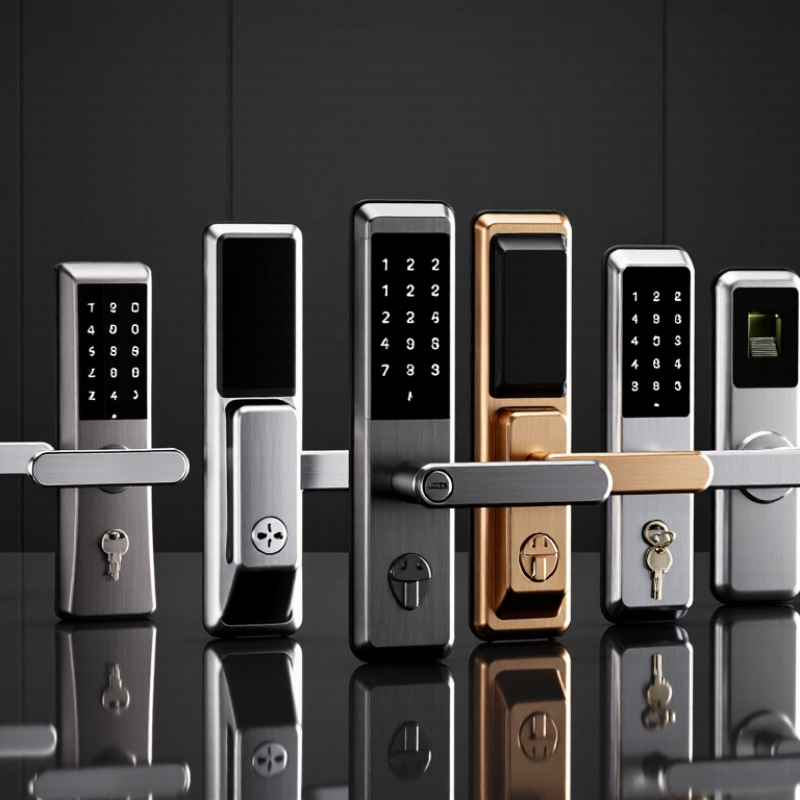
China’s main-door lock manufacturers offer mechanical, electronic, and connected products. Common options include mortise locks, deadbolts, keypad entry, RFID cards, and fingerprint readers. Some models pair a fingerprint sensor beside the handle with an app, access logs, and a low-battery alert. More advanced systems may add face recognition or connect to a home gateway. These features vary by model, so buyers should check actual specifications rather than rely on broad catalog claims.
Grand View Research estimated the global smart-lock market at about USD 2.8 billion in 2023 and projected a 19.6% compound annual growth rate from 2024 to 2030. That demand helps explain manufacturers’ focus on biometric access, remote management, and integration with home systems. However, added connectivity also means more components to configure and maintain. A fingerprint reader can misread a damp finger. Not always seamless. Mechanical keys or another backup entry method still matter.
Tips: Ask for test reports covering durability and environmental conditions. Check the lock’s fit with your door, battery replacement process, and offline access options. On a showroom sample, try the handle, keypad, and bolt several times; small delays are easy to miss in a product brochure.
How to Compare Manufacturers for Different Needs
A manufacturer suited to a home renovation may not fit a hotel or factory project. Start with the door. Compare lock type, door thickness, usage frequency, and installation conditions before reviewing price. A simple interior lock has different demands from a main entrance exposed to rain, dust, or repeated daily use.
Ask how each supplier checks durability. Request test reports for cycle life, corrosion resistance, and performance across expected temperatures. Confirm that the tested model matches the one being quoted; similar-looking products can use different materials or internal parts. Samples help. Inspect the finish, latch movement, key action, and screw alignment yourself. A smooth sample is useful, but it cannot replace clear quality-control records or a factory audit.
For larger projects, compare production capacity, customization limits, minimum order quantities, and realistic lead times. Ask what happens when a shipment has defects, and get warranty terms in writing. Smaller buyers may value flexible order sizes and responsive support more than extensive customization. One detail is easy to miss: a low unit price can bring higher installation or maintenance costs later. I would not trust a polished catalog alone. Compare written specifications, sample quality, and communication side by side; the best fit is not always the supplier with the longest product list.
Who Are the Top 10 Main Door Lock Manufacturers in China? - How to Compare Manufacturers for Different Needs
Comparison of 10 common manufacturer capability profiles—not a verified company ranking. Use the listed checks to assess suppliers against your project requirements.
| No. | Manufacturer Capability Profile | Typical Product Focus | Best Fit | Key Comparison Points | Documents and Samples to Request |
|---|---|---|---|---|---|
| 1 | Mechanical mortise-lock specialist | Lock cases fitted into a pocket cut in the door edge; may be supplied with separate handles and cylinders. | Projects needing conventional key-operated entry and replaceable components. | Case dimensions, backset, handing, spindle position, cylinder compatibility, finish consistency, and replacement-part availability. | Dimensioned drawings, installation template, material specification, and a complete sample set. |
| 2 | Mechanical cylindrical-lock producer | Key-in-knob or lever locksets installed through prepared holes in the door. | Interior and light-duty door applications where compatible door preparation is available. | Door-thickness range, hole spacing, latch dimensions, handing options, keying arrangements, and finish choices. | Installation instructions, dimensional drawings, cycle-test details, and samples for the target door thickness. |
| 3 | Deadbolt and auxiliary-lock producer | Separate deadbolts and supplementary locks, commonly used alongside a primary lockset. | Residential doors needing an additional locking point or a straightforward mechanical retrofit. | Bolt throw, strike-plate design, door and frame alignment tolerance, cylinder options, and installation compatibility. | Product drawings, mounting hardware list, installation guide, and a sample tested on a representative door and frame. |
| 4 | Rim-lock and surface-mounted-lock producer | Lock bodies mounted on the door surface, with a matching keeper attached to the frame. | Retrofits or door constructions where installing a mortise case is unsuitable. | Body size, mounting pattern, keeper adjustment, door swing, cylinder type, and resistance to loosening in service. | Mounting template, keeper drawings, hardware specification, and a sample with all fixing parts. |
| 5 | Multipoint-lock-system producer | Door-edge systems that operate locking points at more than one position, often through a long faceplate and linked hardware. | Doors designed for multipoint hardware and projects seeking distributed engagement along the door edge. | Faceplate length, locking-point layout, backset, door preparation, handle operation, and compatibility with the frame. | Full-size layout drawing, door-preparation specification, operating instructions, and a complete mechanism sample. |
| 6 | Fingerprint smart-lock assembler | Electronic door locks with fingerprint access, typically combined with other entry methods and a mechanical override. | Residential or rental properties seeking keyless access options. | Supported door and lock-body dimensions, enrollment and deletion controls, power and low-battery behavior, emergency access, and service support. | User manual, battery and emergency-power details, test reports for the offered model, and a sample for installation and usability checks. |
| 7 | Keypad and connected-lock producer | Code-operated electronic locks; some models also support app, card, or remote-management functions. | Homes, serviced apartments, or managed properties requiring temporary or changeable access codes. | Available access methods, connectivity requirements, administrator controls, data handling, software support, and operation during network outages. | Connectivity specification, privacy and data-handling documentation, app support terms, operating guide, and a working sample. |
| 8 | Hotel and card-access lock producer | Card-operated door locks designed for managed accommodation, sometimes paired with an access-management system. | Hotels and other sites where staff need to issue, update, or revoke guest access. | Card technology, management-software compatibility, audit functions, offline behavior, installation requirements, and technical support. | System architecture, software demonstration, compatibility list, maintenance terms, and an end-to-end sample installation. |
| 9 | Emergency-exit hardware producer | Exit devices and related door hardware intended to permit operation from the egress side in specified applications. | Commercial projects where door function and life-safety requirements must be checked against local codes. | Door type and width, operating method, compatibility with other hardware, applicable approvals, and project-specific code requirements. | Applicable certificates and test reports for the exact model, installation instructions, and confirmation from the project designer or authority. |
| 10 | OEM and custom-assembly manufacturer | Made-to-order lock assemblies, finishes, packaging, or combinations of mechanical and electronic components. | Importers and project buyers needing specification changes or coordinated private-label production. | Engineering-change control, tooling ownership, minimum order quantities, component traceability, inspection process, and delivery lead time. | Approved drawings, bill of materials, quality-control plan, pre-production sample, and written terms for changes and tooling. |
Comparison note: These profiles describe product and manufacturing capabilities, not named companies or independently verified rankings. Confirm specifications, certifications, test reports, and compatibility for the exact model and destination market before placing an order.