
2026 Top Marine Trolling Motor Battery Types for Buyers
Choosing a Marine Trolling Motor Battery is not just a question of buying the largest capacity available. Battery chemistry affects weight, runtime, charging needs, and how the system performs on the water. A lead-acid battery may suit buyers watching upfront cost, while AGM designs offer a sealed option with less routine maintenance. Lithium batteries can reduce weight and provide useful capacity, but they require compatible charging equipment and careful attention to manufacturer specifications.
Marine systems author Nigel Calder is a respected source on boat electrical systems. A practical paraphrase of his guidance is: “Size the battery and charging system for the boat’s actual electrical demands.” That principle matters when a trolling motor runs for hours against wind or current. A battery that looks adequate at the dock may struggle during a long fishing day. Details count.
This guide compares common battery types for 2026, including their strengths, trade-offs, and typical buyer considerations. It also explains how capacity, motor voltage, charging compatibility, and available space shape a sensible choice. Check the motor and battery makers’ specifications before purchasing; similar-looking batteries can have different limits. No option is perfect. Even a promising choice deserves a second look against your boat, usage, and budget.
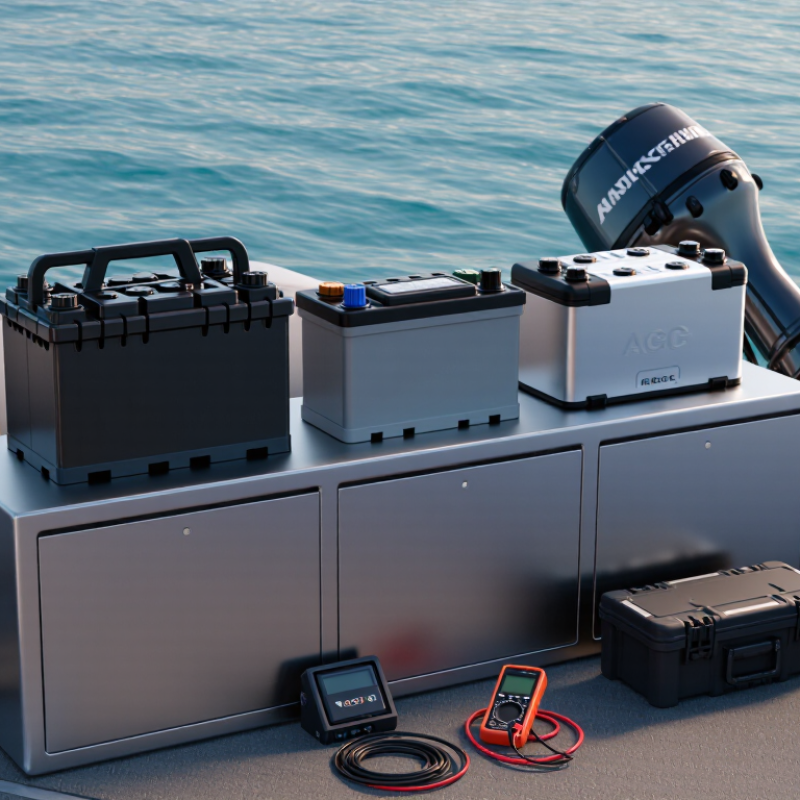
Trolling Motor Battery Basics: 12V, 24V, and 36V Systems
A 12V trolling motor system is often the simplest fit for a small boat and modest thrust needs. A 24V setup typically connects two 12V batteries in series; a 36V setup uses three. Series wiring raises voltage, but it does not add amp-hour capacity. For example, three 12V, 100Ah batteries provide a 36V, 100Ah bank, or about 3.6kWh nominal energy. That calculation follows the basic voltage-times-capacity method used in battery engineering; actual usable energy depends on battery chemistry, load, temperature, and discharge limits. The American Boat & Yacht Council’s E-11 standard is a relevant reference for marine electrical-system installation and protection.
Choose voltage to match the motor’s required input, not just the boat’s size. Higher-voltage systems can deliver the same power with less current, which may reduce cable losses when properly designed. Still, undersized wiring, loose terminals, and poor ventilation can create problems. Measure cable runs and check the motor manual before buying batteries. It is easy to overlook.
Tips: Keep batteries matched in chemistry, capacity, age, and charge state. Secure them against movement, and use suitable overcurrent protection. A 36V bank may offer longer runtime at a given power, but it also adds weight, cost, and charging complexity. For charging and battery-care guidance, consult the battery maker’s specifications and ABYC E-11 rather than relying on a rough runtime estimate.
2026 Top Marine Trolling Motor Battery Types for Buyers - Trolling Motor Battery Basics: 12V, 24V, and 36V Systems
| Battery Type | Nominal Voltage | Common 12V, 24V, and 36V Setups | Usable-Capacity Planning | Approx. Weight per 100Ah | Buyer Considerations |
|---|---|---|---|---|---|
| Flooded Lead-Acid | About 12V per battery | One 12V battery for a 12V system; two in series for 24V; three in series for 36V. | For longer service life, plan to use roughly 50% of rated capacity before recharging. | Approximately 55–70 lb (25–32 kg) | Usually has a lower purchase cost, but is heavy and requires regular maintenance. Use only in a properly ventilated battery compartment; check electrolyte levels as directed. |
| AGM Lead-Acid | About 12V per battery | One 12V battery for a 12V system; two in series for 24V; three in series for 36V. | A conservative planning target is about 50% of rated capacity. | Approximately 60–75 lb (27–34 kg) | Sealed and maintenance-free in normal use, but still heavy. Use a charger profile suitable for AGM batteries and follow the battery maker’s charging instructions. |
| Lithium Iron Phosphate (LiFePO₄) | About 12.8V per battery; common nominal pack voltages are 25.6V and 38.4V for 24V and 36V-class systems. | Use a battery or series arrangement specifically rated for the motor’s required voltage. Series connection is supported only when permitted by the battery manufacturer. | Many systems can plan for roughly 80–90% of rated capacity, subject to the battery’s specifications and BMS limits. | Approximately 22–30 lb (10–14 kg) | Typically offers lower weight and more usable capacity per rated amp-hour. Confirm motor and charger compatibility, continuous-current rating, cold-weather charging limits, and BMS requirements. |
| Choosing a System Voltage | Match the motor’s rated voltage | 12V motors use a 12V bank; 24V motors use a 24V bank; 36V motors use a 36V bank. Lead-acid banks commonly use batteries connected in series. | In a series string, voltage increases while amp-hour capacity stays the same as that of one battery in the string. | Depends on chemistry and battery count | Never connect a battery bank at a voltage different from the motor’s rating. Use batteries with matching chemistry, capacity, age, and state of charge in a series bank. |
| Note: Weight and usable-capacity figures are approximate planning ranges, not specifications for every battery. Actual performance varies with design, temperature, discharge rate, age, and manufacturer guidance. Check the motor and battery documentation before selecting or wiring a system. | |||||