
What Are Plastic Injection Molding Machines?
Plastic Injection Molding Machines are the industrial systems that transform polymer pellets into precise, repeatable products. They heat plastic, inject it into a mold, apply pressure, and cool the formed part. The sequence sounds simple. It is not always simple.
A typical machine combines a hopper, heated barrel, screw, injection unit, clamping unit, and control system. Each component affects product quality. A worn screw may create inconsistent shots. Poor temperature control can leave burns, sink marks, or incomplete edges. Skilled technicians watch pressure curves, cooling time, mold alignment, and material moisture. They do not rely only on the machine’s display.
John Bozzelli, a respected scientific molding educator, often teaches, “If you cannot measure it, you cannot improve it.” This principle explains why modern Plastic Injection Molding Machines use sensors and stored process data. Operators can compare cycle times, injection pressure, cushion position, and energy use. Those details help factories reduce waste and stabilize production.
Still, automation does not remove human judgment. A machine may report acceptable settings while a thin rib warps after cooling. That mistake can expose weak process assumptions. Engineers must test samples, inspect dimensions, and question unusual results. Material choice matters too. Nylon, polypropylene, and recycled polymers behave differently under heat and pressure.
This guide explains machine types, operating stages, key components, and selection factors. It also considers maintenance, safety, energy efficiency, and practical production limits. The goal is not to promise perfect molding. Real factories rarely achieve perfection. The goal is dependable control, informed decisions, and better results over time.
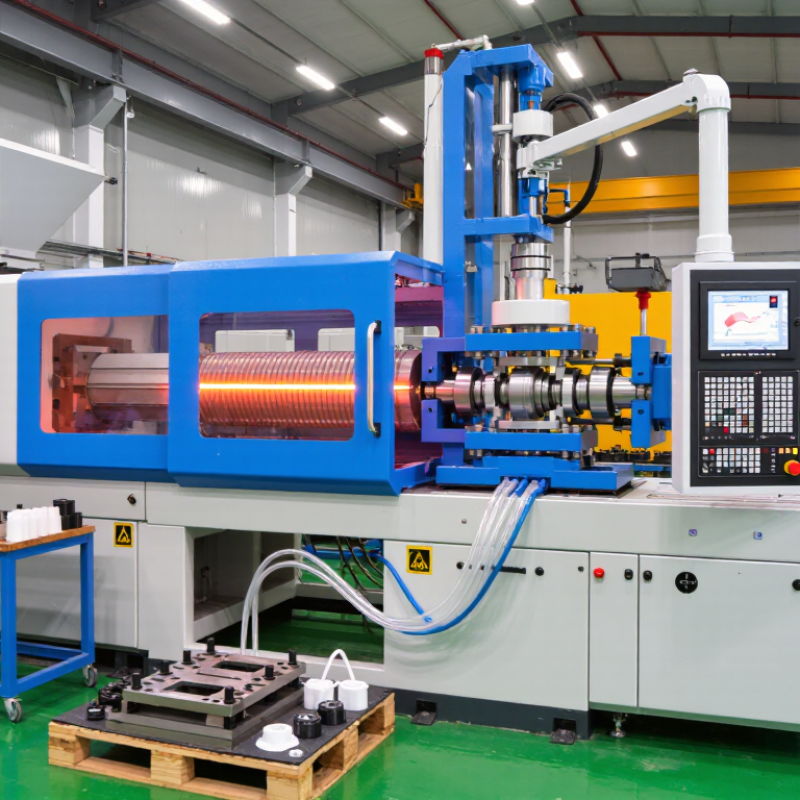
What Is a Plastic Injection Molding Machine?
What Is a Plastic Injection Molding Machine?
A plastic injection molding machine converts polymer pellets into precise molded parts. Pellets enter through a hopper and move along a heated barrel. A rotating screw melts, mixes, and pushes the material forward. The clamping unit then locks two mold halves together. Under controlled pressure, molten plastic fills the cavity and copies its geometry.
The machine holds pressure while the part cools. After cooling, the mold opens, and ejector pins release the component. Cycle settings matter. Temperature, injection speed, pressure, and cooling time can change strength, dimensions, and surface quality. Small errors may create warping, short shots, or visible flow marks. The process looks simple. It is not always forgiving.
According to Grand View Research’s 2024 market assessment, the global injection molding machine market was valued at about USD 16 billion in 2023. PlasticsEurope’s Plastics—the Fast Facts 2024 reported 413.8 million tonnes of global plastics production in 2023. These figures show the scale behind everyday housings, caps, medical components, and automotive parts. However, machine size alone does not guarantee good production. Mold design, material drying, maintenance, and operator experience remain decisive. In practice, a carefully tuned mid-sized machine can outperform a larger machine with poor process control. That is an easy point to overlook.
What Are Plastic Injection Molding Machines? - What Is a Plastic Injection Molding Machine?
| Data Dimension | Typical Value or Range | What It Describes | Practical Significance |
|---|---|---|---|
| Basic Function | Melting, injecting, packing, cooling, and ejecting | A machine heats plastic pellets, injects the melt into a mold cavity, allows the part to cool, and removes the finished product. | These coordinated stages convert thermoplastic raw material into repeatable molded parts. |
| Main Machine Sections | Injection unit, clamping unit, hydraulic or electric drive, control system, and material hopper | The primary mechanical and control assemblies used during molding. | Each section affects injection accuracy, mold safety, cycle time, and production consistency. |
| Clamping Force | Approximately 20–4,000 metric tons | The force used to keep the mold closed while molten plastic is injected. | Required clamping force depends mainly on projected part area, cavity pressure, and mold design. |
| Injection Pressure | Approximately 700–2,500 bar | The pressure used to push molten plastic through the nozzle, runner system, and mold cavity. | Thin walls, long flow paths, and difficult materials generally require higher injection pressure. |
| Shot Size | Approximately 1–100,000 g of polystyrene equivalent | The maximum amount of material that the injection unit can deliver in one molding cycle. | The selected shot size should normally provide sufficient capacity without operating the machine at its limit. |
| Mold Size Compatibility | Varies by machine; commonly about 150–2,000 mm between tie bars on medium and large machines | The mold must fit within the available tie-bar spacing, platen dimensions, and machine daylight. | Machine selection must consider mold width, height, weight, opening stroke, and ejection requirements. |
| Mold Opening Stroke | Approximately 150–2,000 mm | The distance the moving platen travels to open the mold. | The stroke must be long enough to remove the molded part and accommodate the mold construction. |
| Cycle Time | Approximately 5–120 seconds | The time required to complete injection, packing, cooling, mold opening, ejection, and mold closing. | Small thin-walled parts may have short cycles, while large or thick parts require longer cooling periods. |
| Common Machine Types | Hydraulic, all-electric, hybrid, and vertical injection molding machines | Machines are classified by drive system and physical configuration. | Hydraulic systems provide broad size availability; electric systems offer precise movement and efficient repeatability; vertical machines are useful for inserts and overmolding. |
| Typical Materials | PP, PE, ABS, PS, PC, PA, POM, PET, and thermoplastic elastomers | Common thermoplastics processed by injection molding. | Barrel temperature, screw design, drying requirements, and mold temperature must match the material. |
| Barrel Temperature | Approximately 160–400°C, depending on the polymer | The temperature range used to melt and process the selected thermoplastic. | Actual settings vary by resin grade, screw design, residence time, and required flow behavior. |
| Mold Temperature | Approximately 20–150°C, depending on the material and part requirements | The temperature maintained in the mold during filling and cooling. | Higher mold temperatures can improve surface finish and reduce stress for some engineering polymers. |
| Drive System | Hydraulic pumps, servo-hydraulic systems, electric motors, or a combination | The power system that controls screw rotation, injection, clamping, and platen movement. | The drive technology influences energy consumption, noise, motion accuracy, and maintenance requirements. |
| Automation Options | Part-removal robots, conveyors, dryers, temperature controllers, material loaders, and vision inspection | Auxiliary equipment integrated with the molding cell. | Automation can improve cycle consistency, reduce manual handling, and support continuous production. |
| Typical Applications | Automotive components, medical parts, electrical housings, packaging, appliances, and consumer products | Industries and products manufactured using injection molding. | The required machine size and configuration depend on part dimensions, material, tolerance, surface finish, and production volume. |
| Key Selection Factors | Clamping force, shot size, injection pressure, mold dimensions, cycle time, material, and automation needs | The main technical criteria used to select a suitable machine. | Correct sizing helps prevent flash, incomplete filling, excessive wear, unstable quality, and unnecessary operating costs. |
Note: The values shown are general industry ranges for orientation. Actual specifications vary according to machine design, mold construction, plastic grade, part geometry, and processing conditions.