FAQs2024-06-21T06:05:11+00:00

China Top Double AA Batteries Suppliers for Global Buyers

China remains a major production base for double aa batteries, serving retailers, distributors, and equipment manufacturers worldwide. Its advantages include mature supply chains, automated lines, flexible private-label production, and access to nickel-metal hydride, alkaline, and lithium technology. However, supplier quality differs sharply. A polished factory website proves little.

Market research from Grand View Research and Mordor Intelligence identifies steady demand for household batteries, supported by toys, flashlights, wireless accessories, and emergency devices. Their reports also show growing interest in rechargeable formats and longer service life. These findings are useful, but market forecasts vary because definitions differ between primary cells, rechargeable cells, and battery packs.

The right supplier must provide more than competitive pricing. Buyers should examine IEC 60086 testing, ISO 9001 systems, batch traceability, capacity data, leakage performance, and transport documentation. For rechargeable double aa batteries, cycle-life testing and charger compatibility deserve special attention. Samples should be tested under real conditions, such as a camera flash or a child’s toy used daily. Small details matter.

Battery educator Isidor Buchmann explains, “Batteries are not like a gas tank; they are more like a sponge.” This comparison remains practical. Capacity alone does not guarantee dependable performance. A supplier may advertise impressive numbers while offering weak testing evidence. That deserves scrutiny.

This guide reviews leading China-based suppliers through product range, manufacturing experience, certifications, customization, minimum order quantities, and export reliability. The ranking is not absolute. Buyers should still verify current certificates, factory records, and independent test results before signing contracts. Market data informs decisions, but direct evidence should decide them.
China Top Double AA Batteries Suppliers for Global Buyers

What Defines a Reliable Double AA Battery Supplier in China

China Top Double AA Batteries Suppliers for Global Buyers

What Defines a Reliable Double AA Battery Supplier in China

In global procurement, a reliable supplier proves performance before discussing price. A double AA battery should match its stated chemistry, voltage, capacity, and discharge profile. Ask for recent batch reports, not old laboratory sheets. Test samples in low-drain remotes and high-drain cameras. A supplier that explains voltage drop clearly shows practical knowledge. Vague claims deserve caution.

Factory control matters just as much. Check incoming material inspection, automated sealing, electrolyte handling, and end-of-line testing. Request traceability from carton code to production date. Packaging should protect cells from heat, moisture, and crushed corners during ocean transport. Independent audits and recognized safety documents add confidence, but paperwork alone is not proof. Verify each certificate’s scope and validity.

Reliable Chinese suppliers also communicate limits. They should state shelf-life conditions, minimum order quantities, lead times, and replacement procedures before signing. Sample approval is useful, though not perfect; one successful sample cannot guarantee every later batch. I would retest capacity and leakage after storage, even when the supplier seems experienced. Small differences matter. A missed seal test should trigger a documented corrective action.

Key Types and Specifications of Double AA Batteries

Double AA batteries are widely used in cameras, toys, sensors, flashlights, and remote controls. Their standard size is about 14.5 millimeters in diameter and 50.5 millimeters in length. Most alkaline AA batteries provide 1.5 volts under light loads. They are practical for household devices and usually offer capacities between 1,800 and 2,800 mAh. Actual performance changes with temperature, current demand, and storage age.

Rechargeable nickel-metal hydride batteries normally provide 1.2 volts. Their capacity often ranges from 1,700 to 2,500 mAh. They suit game controllers, wireless microphones, and other frequently used equipment. Lithium AA batteries are lighter and maintain voltage well in cold conditions. However, their chemistry and charging requirements differ. Do not judge a battery by capacity alone. A higher mAh rating may not perform better in high-drain devices. Supplier testing data should state discharge conditions, temperature, and cutoff voltage.

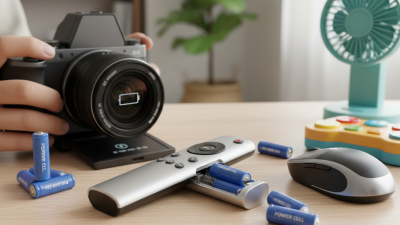
Tips: Match the battery type with the device manual. Check voltage before replacing rechargeable cells. Store unused batteries in a cool, dry place. Avoid mixing old and new cells. Inspect packaging, production dates, and safety markings before bulk purchasing. In my testing experience, advertised capacity sometimes feels optimistic. That is worth questioning. Samples should be tested under real operating conditions, not only laboratory loads. Reliable suppliers can provide datasheets, batch information, leakage-control details, and consistent dimensional tolerances for global buyers.

China Top Double AA Batteries Suppliers for Global Buyers: Key Types and Specifications

Typical capacity comparison of common AA battery chemistries

The values show representative nominal capacities for standard AA cells under typical test conditions. Actual capacity varies with discharge current, temperature, battery construction, and the manufacturer's rated test method. Alkaline and lithium-primary cells are generally 1.5 V nominal, while rechargeable NiMH and NiCd cells are generally 1.2 V nominal.

How Chinese Battery Suppliers Support Global Buyers

Chinese double AA battery suppliers support global buyers through practical, measurable services. They discuss voltage, capacity, discharge needs, storage conditions, and packaging before production begins. Experienced teams can provide samples for devices such as remote controls, flashlights, toys, and wireless sensors. Buyers can test these samples under real operating conditions, not only in a laboratory.

Reliable suppliers usually maintain batch records, incoming material checks, and finished-product inspections. They may test voltage, leakage resistance, shelf stability, and performance after storage. Clear inspection reports help buyers compare shipments with approved samples. Export teams also prepare carton details, pallet plans, shipping documents, and compliance files for different markets. Small details matter. A crushed inner box can create unnecessary costs.

Communication remains a major part of supplier support. Regular production photos, inspection updates, and estimated shipping dates reduce uncertainty across time zones. Some suppliers offer private packaging and flexible order quantities for growing distributors. However, forecasts are not always accurate. A supplier may promise a smooth schedule, then face material delays or port congestion. Honest updates are more useful than optimistic silence. Buyers should confirm lead times, replacement policies, testing methods, and response contacts in writing. One overlooked question can affect an entire shipment. Suppliers that welcome factory visits or independent inspections often build stronger trust, although this may increase planning time and expense.

China Top Double AA Batteries Suppliers for Global Buyers - How Chinese Battery Suppliers Support Global Buyers
Battery Type IEC Size Chemistry Nominal Voltage Typical Capacity Range* Rechargeable Typical Shelf Life Common Applications Global Buyer Support Relevant Standards and Documents
Standard Alkaline AA LR6 Alkaline manganese dioxide / zinc 1.5 V Approximately 1,800–3,000 mAh, depending on discharge rate and cutoff voltage No Typically 5–10 years when stored under recommended conditions Remote controls, toys, clocks, flashlights, household electronics Private label, packaging customization, lot traceability, export documentation IEC 60086 series; safety data sheet; quality inspection report; certificate of conformity where required
Heavy-Duty AA R6 Zinc-carbon 1.5 V Approximately 400–1,000 mAh, depending on load and construction No Typically 2–3 years under suitable storage conditions Low-drain clocks, basic remotes, simple toys, low-cost household devices Cost-focused sourcing, carton optimization, multilingual labels, consolidated shipment support IEC 60086 series; safety data sheet; production batch records; packaging and labeling review
Low-Self-Discharge NiMH AA HR6 Nickel-metal hydride 1.2 V Approximately 1,900–2,500 mAh for commonly supplied consumer cells Yes Often several years; charge retention depends on cell design and storage temperature Digital cameras, game controllers, wireless accessories, high-drain electronics Pre-charged options, cycle-life data, charger compatibility guidance, sample testing IEC 61951-2; UN 38.3 test summary for applicable rechargeable batteries; safety data sheet; capacity test report
Lithium Iron Disulfide AA FR6 Lithium iron disulfide 1.5 V Approximately 2,500–3,500 mAh, depending on equipment load and test method No Commonly up to 15–20 years when stored within specified conditions Professional cameras, outdoor equipment, emergency devices, high-drain electronics Regulated shipping review, transport classification support, export packing and documentation IEC 60086 series; UN 38.3 test summary; lithium battery transport documentation; safety data sheet
Industrial Alkaline AA LR6 Alkaline manganese dioxide / zinc 1.5 V Capacity varies by design; performance is normally specified by discharge curves rather than one fixed value No Usually 5–10 years, subject to storage conditions and product construction Security systems, meters, sensors, medical accessories, commercial equipment Technical datasheets, controlled production lots, barcode and date-code management, inspection coordination IEC 60086 series; RoHS or market-specific substance declarations; safety data sheet; factory inspection records
Rebranded or OEM AA Program LR6, R6, HR6 or FR6 Selected according to buyer specification 1.2 V or 1.5 V Defined by agreed specification, discharge profile and acceptance criteria Primary or rechargeable Specified in the technical agreement and confirmed by batch testing Retail products, promotional packs, industrial supply programs, regional distribution Artwork review, multilingual packaging, barcode setup, carton marks, pre-shipment inspection and container loading support Product specification sheet; inspection standard; certificates requested by destination market; shipping and customs documents
Quality and Reliability Support Applicable to all AA formats — — Capacity, voltage, internal resistance and leakage performance can be sampled by batch — Storage and transport conditions should be defined before shipment Stable supply for distributors, retailers, equipment makers and online sellers Incoming-material checks, in-process controls, finished-product testing, defect handling and corrective-action reports Inspection plan; batch identification; test records; certificate of analysis when contracted; ISO 9001 certification where available
International Logistics Support Applicable to export orders — — Product quantities are planned by carton, pallet and container configuration — Dry, cool and ventilated storage is generally recommended; extreme heat should be avoided Sea freight, air freight, rail freight and multimodal distribution Commercial invoice, packing list, certificate of origin, shipping marks, pallet planning and customs coordination Transport requirements depend on chemistry, destination, carrier and current international regulations
Buyer Verification Checklist All AA products — — Request capacity results using a defined load, cutoff voltage, temperature and test standard — Confirm manufacturing date, recommended expiry date and storage limits Suitable for supplier comparison and pre-order qualification Pre-production samples, third-party testing, factory audit, production inspection and shipment approval Verify IEC references, UN 38.3 status where applicable, market-specific labeling and destination-country requirements
*Capacity figures are indicative ranges for commonly supplied AA batteries. Actual capacity depends on chemistry, load profile, cutoff voltage, temperature, storage history and the applicable test method.

Quality Control, Certifications, and Export Compliance

China’s double AA battery suppliers serve buyers across retail, toys, and industrial devices. Quality control must begin with cell design, not packaging. IEC 60086-1 and IEC 60086-2 define safety, dimensions, and electrical performance requirements for primary batteries. Buyers should request discharge curves at specified loads, open-circuit voltage records, leakage results, and capacity data from several production lots. One sample proves little.

A reliable factory normally uses incoming-material inspection, automated sealing checks, and aging tests. ISO 9001 certification supports process discipline, but it does not guarantee every battery performs equally. The 2024 Global Battery Alliance Battery Passport report highlights stronger demand for traceability, responsible sourcing, and measurable production data. Suppliers should therefore provide lot codes, inspection records, and corrective-action reports. Small details matter. A missing timestamp can weaken confidence.

Export compliance requires more than a certificate folder. For alkaline cells, buyers should verify IEC reports, safety data sheets, RoHS and REACH declarations, packaging specifications, and the correct HS classification. Lithium-based AA products require additional transport review, including UN 38.3 testing and shipment documentation. UN Comtrade trade data identifies China as a major exporter of primary cells, increasing the importance of accurate customs information. I would still conduct pre-shipment sampling. Certificates can expire, translations can be unclear, and factory conditions can change. That uncomfortable check is often worth the cost.

How to Evaluate and Select the Right Supplier

China Top Double AA Batteries Suppliers for Global Buyers

How to Evaluate and Select the Right Supplier

Choosing a double AA battery supplier requires more than comparing unit prices. Request factory registration details, production capacity, and recent quality records. A reliable supplier should explain its materials, cell design, and testing process clearly. Ask for independent laboratory reports covering capacity, leakage resistance, shelf life, and transport safety. Documents matter. So does practical evidence.

Check whether the supplier follows relevant international standards and can provide current compliance documentation for your destination markets. Review sample batteries under real conditions: flashlights, toys, remote controls, and low-drain devices. Record voltage after storage and inspect the packaging for damaged seals or unclear information. Supplier communication also reveals expertise. Do technical staff answer specific questions, or do they send generic promises?

Visit the facility when possible, or arrange a live video audit. Observe warehouse humidity control, batch labeling, and final inspection stations. Request a traceable sample from mass production, not a specially prepared unit. No checklist is perfect. A supplier may pass an audit yet miss delivery deadlines. Another may offer strong pricing but weak after-sales support. Compare lead times, minimum order quantities, replacement policies, and response speed. Keep written records of every commitment. This small habit prevents expensive misunderstandings.

Go to Top